Philippine administrative boundaries in GeoJSON and TopoJSON, from the regions down to the barangays.
I first wrote this post in June 2019. The project has changed a lot since then, so I rewrote it in October 2026 for the v1.1.0 maps.
The repository has vector maps of the Philippines that you can use right away in a web map, either as an overlay in Leaflet or MapLibre, or drawn on a canvas with d3. Every area carries its Philippine Standard Geographic Code (PSGC) and the codes of its parents, so you can join the maps to PSA statistics or any other dataset keyed by PSGC.
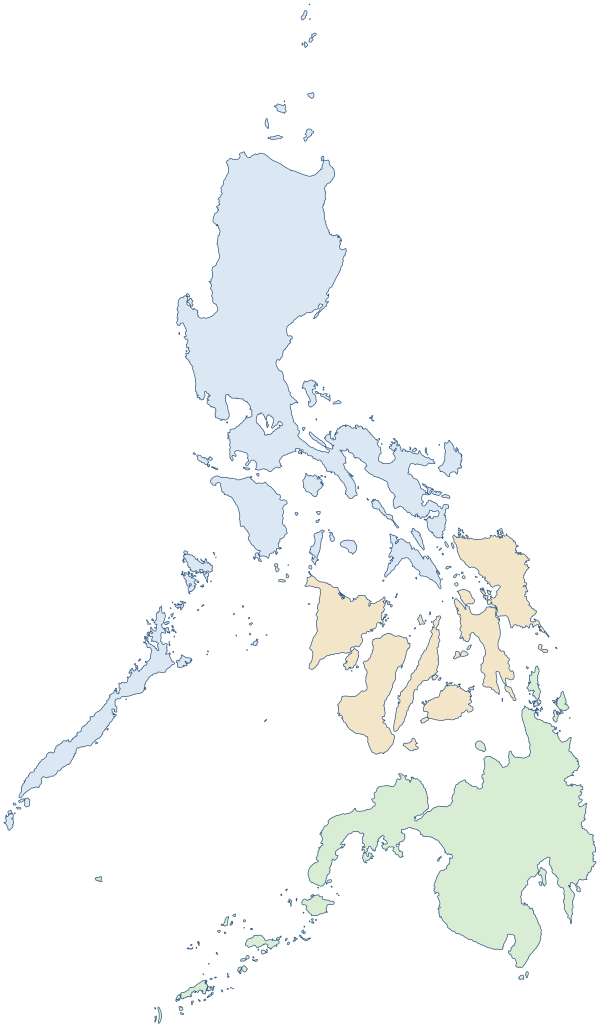
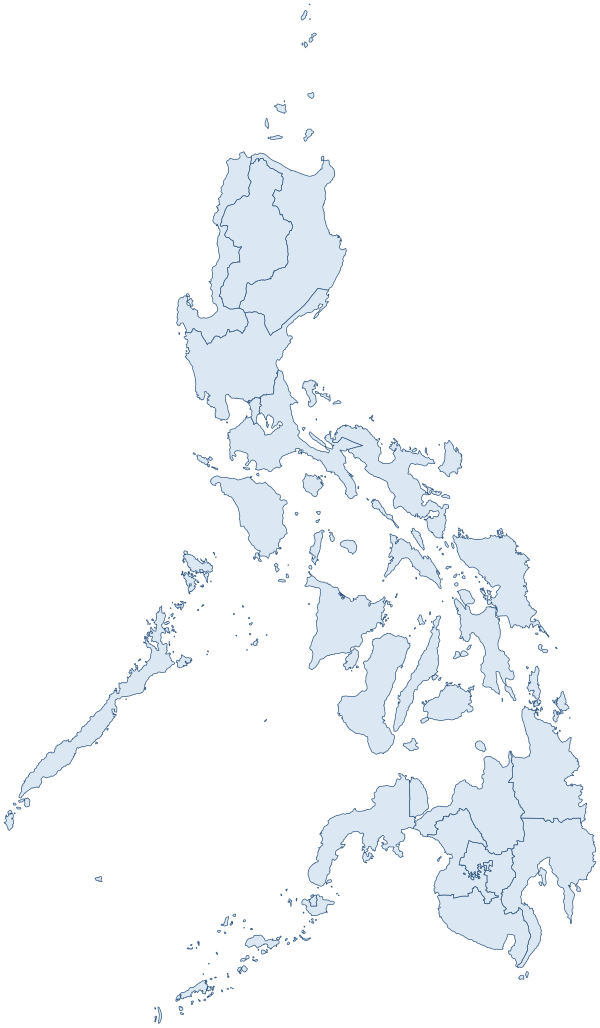
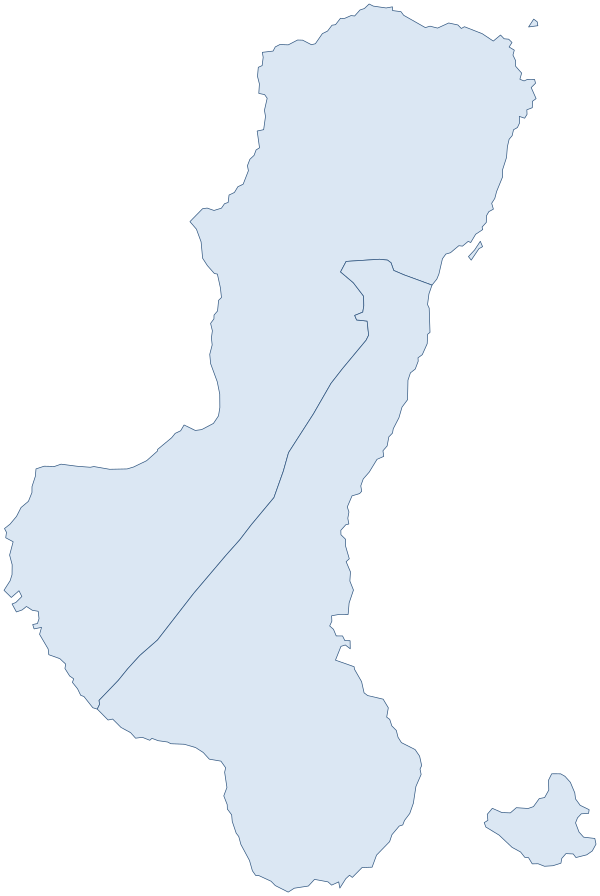
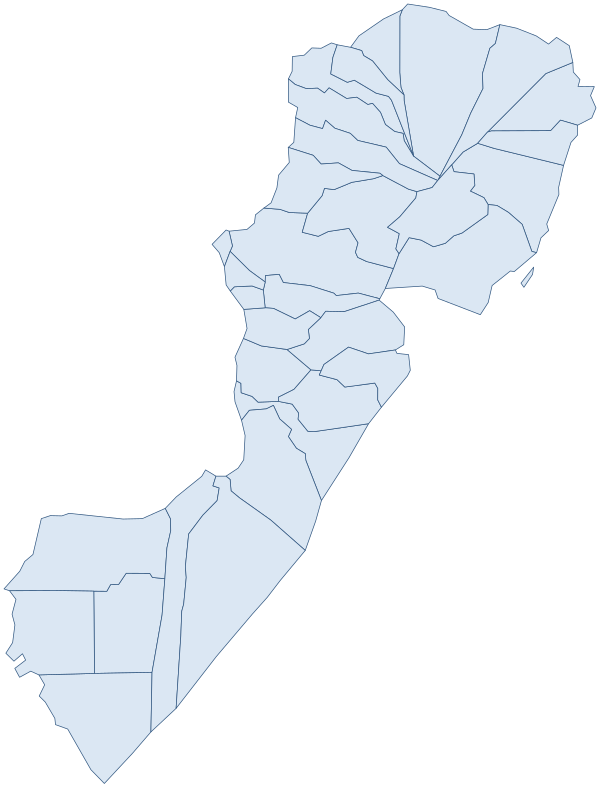
The island groups, the 18 regions, the provinces of the Negros Island Region, and the municipalities and cities of Negros Occidental, drawn from the low resolution files by sample-maps.sh. Boundaries by NAMRIA and PSA, through OCHA’s COD-AB.
Background
A few years ago, I was looking for low resolution map files that I could use to render a natural hazards map on the web. I found high resolution shapefiles, but I still had to do post-processing to make them fit what I needed. Basically, high resolution shapefiles are not practical for web maps because of their file size.
I needed vector maps that render fast. I also wanted to split the map data so I could load parts of the map one at a time, only when they are needed. So I wrote a few scripts to do the conversion and the splitting.
In 2026 I rebuilt the whole thing. The maps now come from the shapefiles in
philippines-psgc-shapefiles, whose
codes and names follow PSA’s PSGC, and they are rebuilt every PSGC quarter. That is why the old
topojson/... paths from 2019 are gone.
Getting the Maps
The medium and low resolution files of the latest quarter are in the latest folder, and you can link to them directly. For example, here are the provinces of Region II in low resolution TopoJSON:
provdists-region-200000000.topo.0.001.json
The latest folder moves to each new quarter, so a file there can change, or even be renamed.
If you need a quarter that never changes, or the high resolution files, use the
releases instead. There is one
release per quarter, with one zip per format and resolution and a SHA256SUMS file to check them
against. A link like
topojson-lowres.zip
always points to the latest one. The older maps are releases too:
2023-4q,
2019 and
2011.
For most web maps, low or medium resolution is enough. Low resolution TopoJSON is the smallest, so it is the one to use for slow connections.
How the Files Are Organised
Each file is one area holding its children. The country file holds the regions, a region file holds its provinces (or, for Metro Manila, its districts), a province or district file holds its municipalities and cities, and a municipality or city file holds its barangays. There is also an island groups file with Luzon, Visayas and Mindanao.
A file’s name tells you what is inside: the children, the parent level and the parent’s PSGC
code, then the simplification. For example, municities-provdist-1804500000.0.001.json holds the
municipalities and cities of Negros Occidental. The simplification is 0.1 for high resolution
(10% of the vertices), 0.01 for medium (1%) and 0.001 for low (0.1%).
A Few Things to Watch Out For
PSGC codes are written as numbers, so the leading zeros are dropped. Region I is 100000000, not
0100000000, both in the file names and in the properties.
Some codes changed in the third quarter of 2026. The Negros Island Region was created from Negros Occidental, Negros Oriental and Siquijor, and Sulu moved to Region IX, so their codes changed and so did the names of their files. The v1.0.0 release notes list every renamed file.
Island groups are not a PSGC level, so they have no code. Each one is the union of its regions, and its name is its id.
How it Works
-
Each level’s shapefile is filtered by parent and reprojected to WGS84 using ogr2ogr.
-
The result is simplified using mapshaper at 10% (hires), 1% (medres) and 0.1% (lowres), keeping every shape.
-
Each one is written as GeoJSON and as the more compact TopoJSON.
You can look at the scripts to see how I did it. I would recommend having a look at these tools if you want to do your own transformations.
Sources and License
The boundaries come from OCHA’s Philippines administrative level 0-4 boundaries (COD-AB), by the National Mapping and Resource Information Authority (NAMRIA) and the Philippine Statistics Authority (PSA), licensed CC BY-IGO. The scripts and maps in my repository are under the MIT License, but if you republish the boundaries, please credit NAMRIA and PSA through OCHA’s COD-AB.
Contributing
Contributions are always welcome, no matter how large or small. Github Project Link